With Blog Buzz, the title is crucial.
Introduction
You may spend hours creating valuable blog content, researching keywords, improving SEO, and carefully editing every sentence. However, none of that matters if readers never click on your post.
Before people read your content, they see your title. In Google search results, social media, and other Web platforms, the headline is often the first opportunity to capture attention and communicate value. A strong title can make readers stop, become curious, and think, “This is exactly what I was looking for.”
That is why creating a successful blog begins before writing the main content. It begins with understanding your audience, their search intent, and the words that encourage them to take action.
So, what makes an effective title? And how can you create a headline that attracts both readers and search engines without relying on clickbait?
In this article, we will explore the relationship between blog titles, SEO, clicks, reader interest, and Buzz, and explain practical ways to create titles that people genuinely want to read.
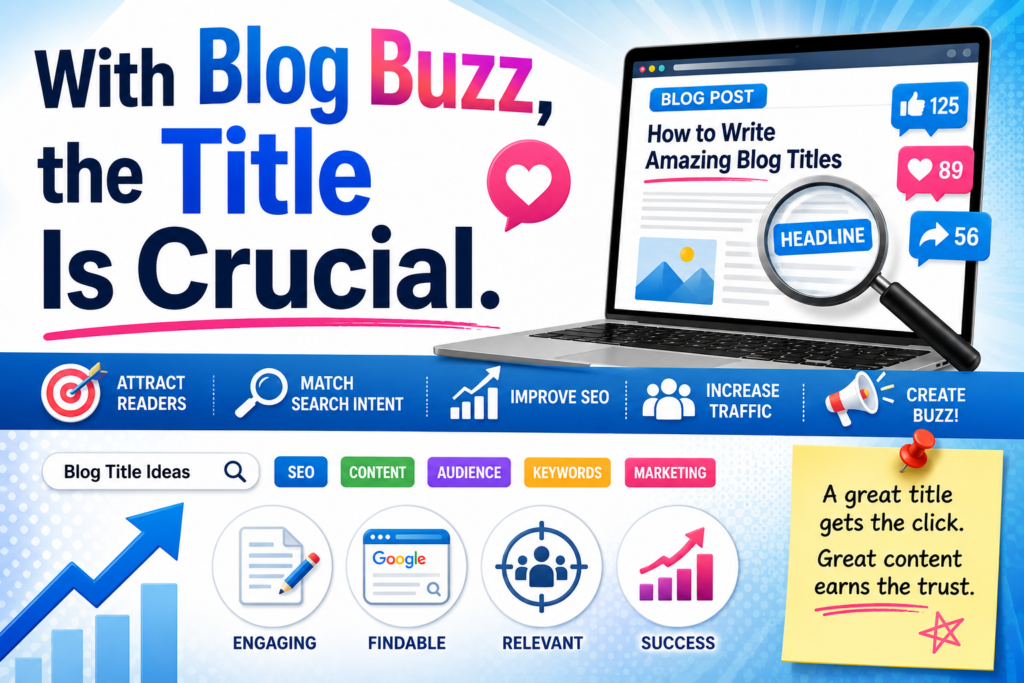
With Blog Buzz, the title is crucial.
With Blog Buzz, the Title Is Crucial
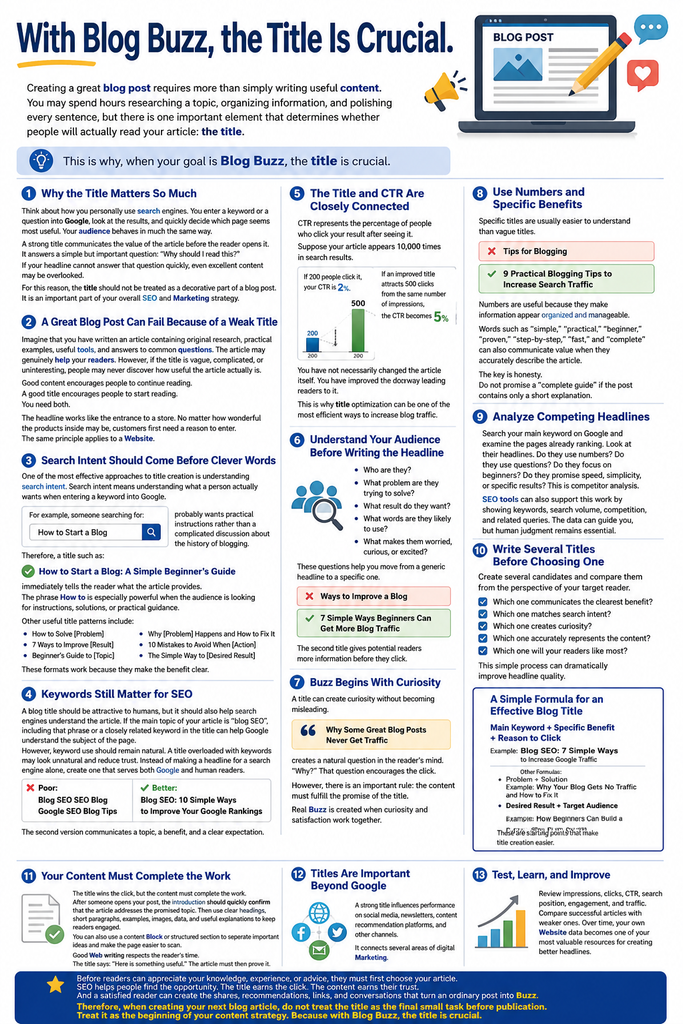
Creating a great blog post requires more than simply writing useful content. You may spend hours researching a topic, organizing information, and polishing every sentence, but there is one important element that determines whether people will actually read your article: the title.
When people discover your Website through Google, social media, or another Web platform, the title is often the first thing they see. Before they know how valuable your article is, they decide whether to click based largely on the headline.
This is why, when your goal is Blog Buzz, the title is crucial.
Why the Title Matters So Much
Think about how you personally use search engines.
You enter a keyword or a question into Google, look at the results, and quickly decide which page seems most useful. You probably do not carefully examine every result. Instead, you scan several titles and select the one that appears to match your needs.
Your audience behaves in much the same way.
A strong title communicates the value of the article before the reader opens it. It answers a simple but important question:
“Why should I read this?”
If your headline cannot answer that question quickly, even excellent content may be overlooked.
For this reason, the title should not be treated as a decorative part of a blog post. It is an important part of your overall SEO and Marketing strategy.
A Great Blog Post Can Fail Because of a Weak Title
Imagine that you have written an article containing original research, practical examples, useful tools, and answers to common questions.
The article may genuinely help your readers.
However, if the title is vague, complicated, or uninteresting, people may never discover how useful the article actually is.
This creates an important distinction.
Good content encourages people to continue reading.
A good title encourages people to start reading.
You need both.
The headline works like the entrance to a store. No matter how wonderful the products inside may be, customers first need a reason to enter.
The same principle applies to a Website.
Search Intent Should Come Before Clever Words
One of the most effective approaches to title creation is understanding search intent.
Search intent means understanding what a person actually wants when entering a keyword into Google.
For example, someone searching for:
How to Start a Blog
probably wants practical instructions rather than a complicated discussion about the history of blogging.
Therefore, a title such as:
How to Start a Blog: A Simple Beginner’s Guide
immediately tells the reader what the article provides.
The phrase How to is especially powerful when the audience is looking for instructions, solutions, or practical guidance.
Other useful title patterns include:
How to Solve [Problem]
7 Ways to Improve [Result]
Beginner’s Guide to [Topic]
Why [Problem] Happens and How to Fix It
10 Mistakes to Avoid When [Action]
The Simple Way to [Desired Result]
These formats work because they make the benefit clear.
Keywords Still Matter for SEO
A blog title should be attractive to humans, but it should also help search engines understand the article.
This is where keywords become important.
If the main topic of your article is “blog SEO,” including that phrase or a closely related keyword in the title can help Google understand the subject of the page.
However, keyword use should remain natural.
A title overloaded with keywords may look unnatural and reduce trust. Instead of making a headline for a search engine alone, create one that serves both Google and human readers.
For example:
Poor:
Blog SEO SEO Blog Google SEO Blog Tips
Better:
Blog SEO: 10 Simple Ways to Improve Your Google Rankings
The second version communicates a topic, a benefit, and a clear expectation.
The Title and CTR Are Closely Connected
Another important concept is click-through rate, often called CTR.
CTR represents the percentage of people who click your result after seeing it.
Suppose your article appears 10,000 times in search results.
If 200 people click it, your CTR is 2%.
If an improved title attracts 500 clicks from the same number of impressions, the CTR becomes 5%.
You have not necessarily changed the article itself. You have improved the doorway leading readers to it.
This is why title optimization can be one of the most efficient ways to increase blog traffic.
Understand Your Audience Before Writing the Headline
Before creating a title, think carefully about your target audience.
Who are they?
What problem are they trying to solve?
What result do they want?
What words are they likely to use?
What makes them worried, curious, or excited?
These questions help you move from a generic headline to a specific one.
For example:
Ways to Improve a Blog
is broad.
However:
7 Simple Ways Beginners Can Get More Blog Traffic
has a clearly defined audience and benefit.
The second title gives potential readers more information before they click.
Buzz Begins With Curiosity
If you want an article to become popular, search traffic alone may not be enough. People must also want to share it.
This is where curiosity becomes valuable.
A title can create curiosity without becoming misleading.
For example:
Why Some Great Blog Posts Never Get Traffic
creates a natural question in the reader’s mind.
“Why?”
That question encourages the click.
However, there is an important rule: the content must fulfill the promise of the title.
A sensational headline that leads to weak or unrelated content may produce temporary clicks, but it can damage trust.
Real Buzz is created when curiosity and satisfaction work together.
Use Numbers and Specific Benefits
Specific titles are usually easier to understand than vague titles.
Compare:
Tips for Blogging
with:
9 Practical Blogging Tips to Increase Search Traffic
The second title tells the reader exactly what to expect.
Numbers are useful because they make information appear organized and manageable.
Words such as:
“simple,”
“practical,”
“beginner,”
“proven,”
“step-by-step,”
“fast,”
and “complete”
can also communicate value when they accurately describe the article.
The key is honesty.
Do not promise a “complete guide” if the post contains only a short explanation.
Analyze Competing Headlines
You do not have to create titles without information.
Search your main keyword on Google and examine the pages already ranking.
Look at their headlines.
Do they use numbers?
Do they use questions?
Do they focus on beginners?
Do they promise speed, simplicity, or specific results?
This is competitor analysis.
The purpose is not to copy another title. Instead, identify common patterns and then look for an opportunity to offer something clearer, more useful, or more original.
Various SEO tools can also support this work by showing keywords, search volume, competition, and related queries.
The data can guide you, but human judgment remains essential.
Write Several Titles Before Choosing One
Many bloggers write one title and immediately publish it.
A better method is to create several candidates.
For example, if your topic is increasing blog traffic, you might write:
How to Increase Blog Traffic
10 Ways to Get More Blog Traffic
Why Your Blog Gets No Traffic and How to Fix It
Blog Traffic Guide for Beginners
How I Would Increase Blog Traffic From Zero
7 SEO Changes That Can Increase Blog Traffic
Now compare them from the perspective of your target reader.
Which one communicates the clearest benefit?
Which one matches search intent?
Which one creates curiosity?
Which one accurately represents the content?
This simple process can dramatically improve headline quality.
Avoid Titles That Promise Too Much
Clickbait can attract attention, but excessive promises often create disappointment.
For example:
Use This Secret and Get One Million Blog Visitors Tomorrow!
may attract attention, but unless the article can genuinely support that promise, it damages credibility.
A strong title does not need to deceive people.
Specificity, relevance, curiosity, and usefulness are usually enough.
Readers increasingly recognize exaggerated marketing language. Trust is therefore an important competitive advantage.
Your Content Must Complete the Work
The title wins the click, but the content must complete the work.
After someone opens your post, the introduction should quickly confirm that the article addresses the promised topic.
Then use clear headings, short paragraphs, examples, images, data, and useful explanations to keep readers engaged.
You can also use a content Block or structured section to separate important ideas and make the page easier to scan.
Good Web writing respects the reader’s time.
The title says:
“Here is something useful.”
The article must then prove it.
Titles Are Important Beyond Google
A strong title is useful not only for SEO.
It can influence performance on social media, newsletters, content recommendation platforms, and other channels.
When someone shares your article, the headline may be the primary information another person sees.
This means one strong headline can influence:
search clicks, social shares, email opens, backlinks, brand awareness, and referral traffic.
The title therefore connects several areas of digital Marketing.
Create Titles for Humans First
SEO is important, but humans make the final decision to click.
Google does not become your customer, subscriber, follower, or fan.
People do.
Therefore, instead of asking only:
“Does this title contain my keyword?”
also ask:
“Would I click this title if I had this problem?”
That small change in perspective can significantly improve your headline strategy.
The best titles combine search intent, keywords, relevance, clarity, curiosity, and benefit.
A Simple Formula for an Effective Blog Title
You can use this basic formula:
Main Keyword + Specific Benefit + Reason to Click
For example:
Blog SEO: 7 Simple Ways to Increase Google Traffic
Main keyword: Blog SEO
Specific benefit: Increase Google Traffic
Reason to click: 7 Simple Ways
Another formula is:
Problem + Solution
Example:
Why Your Blog Gets No Traffic and How to Fix It
Or:
Desired Result + Target Audience
Example:
How Beginners Can Build a Popular Blog From Scratch
These formulas are not absolute rules. They are starting points that make title creation easier.
Test, Learn, and Improve
There is no single perfect headline formula for every blog.
Different audiences respond to different words and promises.
Therefore, continue testing.
Review impressions, clicks, CTR, search position, engagement, and traffic. Compare successful articles with weaker ones.
You may discover that your audience prefers questions.
Another audience may respond better to numbers.
Some readers may prefer direct How to titles.
Over time, your own Website data becomes one of your most valuable resources for creating better headlines.
Even unfamiliar or low-value terms such as Ut or eu should never be inserted unnaturally merely to manipulate search visibility. Keywords and related terms should support meaning, not reduce the quality of the article.
Conclusion: Blog Buzz Starts Before the Reader Opens the Article
A successful blog post needs valuable content, but valuable content alone cannot guarantee attention.
Before readers can appreciate your knowledge, experience, examples, or advice, they must first choose your article.
That decision often begins with the title.
A powerful headline identifies the topic, reflects search intent, communicates a benefit, creates appropriate curiosity, and makes the right audience want to continue.
SEO helps people find the opportunity.
The title earns the click.
The content earns their trust.
And a satisfied reader can create the shares, recommendations, links, and conversations that turn an ordinary post into Buzz.
Therefore, when creating your next blog article, do not treat the title as the final small task before publication.
Treat it as the beginning of your content strategy.
Because with Blog Buzz, the title is crucial.