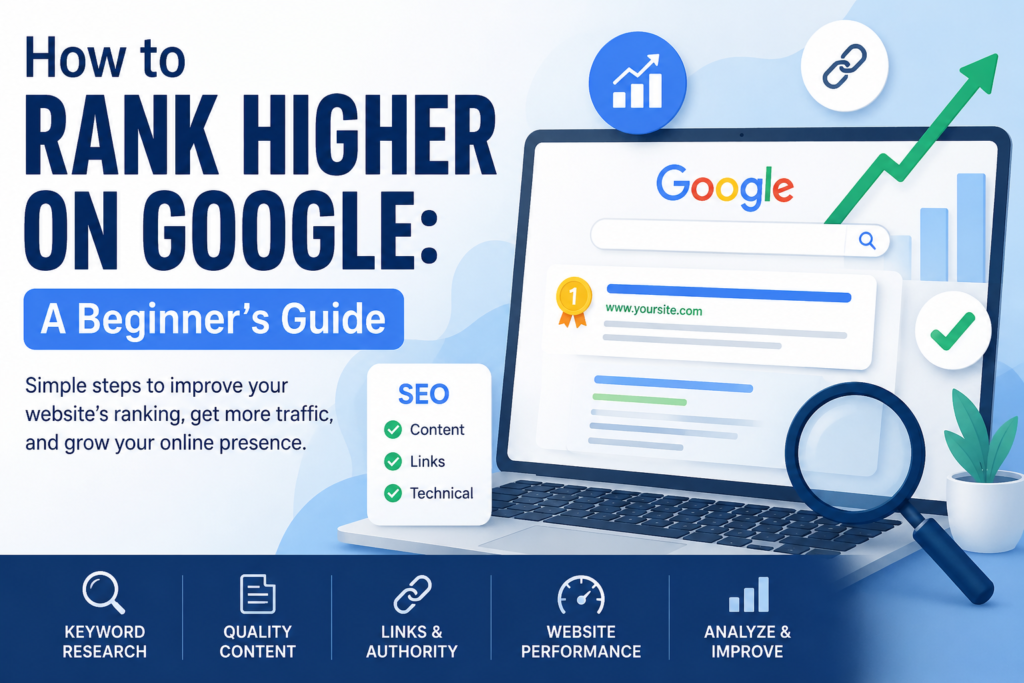
How to Rank Higher on Google: A Beginner’s Guide
Introduction
Getting your website to rank higher on Google may seem difficult, especially when you’re new to SEO. Keywords, content quality, links, search intent, site speed, and Google tools can make SEO feel more complicated than it really is.
But you don’t need to master everything at once.
The key is to understand what people are searching for, create genuinely helpful content, make your website easy to use, and improve it step by step. Google aims to connect users with relevant and useful information, so focusing on the needs of your readers is one of the best places to start.
In this beginner’s guide, you’ll learn the essential steps for improving your Google search visibility—from keyword research and quality content to internal links, website performance, Google Search Console, and Google Analytics.
If you’re wondering, “How can I rank higher on Google?”, start here. You don’t need complicated SEO tricks. You need the right fundamentals, useful content, and consistent improvement.
How to Rank Higher on Google: A Beginner’s Guide
How to Rank Higher on Google: A Beginner’s Guide
Getting your website to rank higher on Google can feel difficult when you’re just getting started. You may hear people talk about SEO, keywords, links, authority, traffic, and technical performance, but not know where to start.
The good news is that you don’t need to become an SEO expert overnight.
What you really need is to understand what Google and your users are looking for, create useful content, build a clear website structure, and continue to improve your site over time.
This beginner’s guide explains How to approach Google search in a practical way. Whether you run a personal blog, a small business website, or an online service, the same basic principles can help you build stronger pages and improve your ranking.
1. Understand What Google Is Trying to Do
Before thinking about how to rank higher, it’s important to understand the basic purpose of Google search.
Google wants to help people find useful, relevant, and trustworthy information.
When a user enters a query, Google tries to determine the user’s intent and find pages that are likely to satisfy that need.
This means SEO isn’t simply about adding a keyword to a page many times. A high-quality page should provide the right information and a good experience.
For Example, imagine someone searches for “best coffee shop near me.”
Google needs to understand several things, including the person’s location, what businesses are nearby, how relevant each business is, and whether the available information is useful.
For a local business, information such as a business name, address, phone number, opening hours, and Google Business Profile can therefore be important.
The same principle applies to a blog.
If people search for information about SEO, your post should answer the specific questions behind that search.
Start with the user rather than the search engine.
2. Keyword Research Gives Your Content Direction
One of the first steps in SEO is keyword research.
A keyword represents what people type into Google when they’re looking for information, a product, or a service.
Good research can tell you what people want to know, how much search volume a topic receives, and what kind of competition you may face.
There are many SEO Tools available for this purpose. Some are free, while others require Registration or a paid plan.
However, don’t choose a keyword only because it has a high search volume.
You also need to think about search intent.
For example, a customer searching for “how to choose running shoes” probably wants a guide. Someone searching for “buy running shoes online” is much closer to making a purchase.
Those two users have different needs.
Choose a main keyword that matches the purpose of your page, and then include related terms naturally in your text.
You don’t need to add every possible phrase. In fact, trying too hard to include keywords can make your writing difficult to read.
The goal is to create something useful for real people.
3. Create a Strong Page Title
Your title is one of the most important parts of a page.
It tells both users and search engines what the page is about.
A good title should be specific, understandable, and closely related to the main topic.
If your article teaches beginners how to improve their Google ranking, a title like:
How to Rank Higher on Google: A Beginner’s Guide
makes the subject immediately clear.
Avoid titles that promise something the page doesn’t deliver.
You should also think about what the title will look like when people see it in search results. A clear title may encourage more people to click, but the page itself still needs to satisfy their expectations.
SEO isn’t just about reaching a high position. You want the right people to visit your website and find what they need.
4. Write Content That Actually Helps People
Quality content is at the center of long-term SEO.
When you Write a blog post, ask yourself:
What problem does this article solve?
What information does the reader need?
What would make this page better than a basic answer already available on the web?
Your content doesn’t have to sound complicated.
In many cases, simple language is better.
Explain the subject clearly, give examples, and add your own experience when it is relevant.
Your first goal should be to help the reader.
Google’s systems have become increasingly capable of understanding whether a page appears useful in context. That doesn’t mean an algorithm understands a page exactly like a human does, but creating content around genuine user needs is a much stronger strategy than writing only for search engines.
If you have direct experience in your industry, use it.
Original observations, practical examples, comparisons, and lessons learned can make a page more valuable.
This is also one way to build trust and authority over time.
5. Use Headings and a Clear Structure
Good content needs a clear structure.
A long wall of text can be difficult to read, especially on a mobile phone.
Use a main title and logical headings to divide your content into sections.
Each section should cover a specific idea.
This makes it easier for users to scan the page and understand where the information they need is located.
Good structure also makes your website easier to maintain as you create more pages.
Keep paragraphs relatively short, use lists when appropriate, and make sure the most important information isn’t buried far down the page.
Before publishing, take another look at the article from a beginner’s perspective.
Would a new visitor understand it?
If not, simplify it.
6. Optimize Your Meta Information
A page also has information that may not appear directly in the main article.
Your meta information can help search engines and users understand the page.
A useful Description summarizes what the page offers.
Good meta descriptions are concise and relevant to the searcher’s needs.
For example:
“Learn how to rank higher on Google with this beginner-friendly SEO guide covering keywords, content, links, site performance, and Google tools.”
A description doesn’t guarantee a higher ranking, and Google may display different text in some search results. Still, writing a useful description is good practice.
You should also pay attention to your title tag, headings, and URL.
A simple, descriptive URL is generally easier for people to understand than a long URL filled with unnecessary numbers and characters.
7. Build Useful Internal Links
Internal linking is one of the easiest SEO improvements for beginners.
Internal links connect one page on your site to another relevant page.
For example, if you’re writing about keyword research and already have a detailed guide about search intent, you can link to that guide.
This helps users discover additional information and creates connections between related pages.
As your blog grows, internal linking becomes even more important.
Don’t create isolated posts that have no connection to the rest of your website.
Instead, think about building groups of useful content around major topics.
If you publish ten SEO articles, for example, connect related articles where doing so genuinely helps the reader.
This creates a stronger information structure and makes navigation easier.
8. Improve Website Speed and Mobile Performance
Great content can be undermined by a poor website experience.
If your site takes too much time to load, some visitors may leave.
That’s why speed and technical performance deserve attention.
Check your website on both desktop and mobile devices.
Make sure that text is readable, menus work correctly, images aren’t unnecessarily large, and important content appears properly.
You don’t need to make your site technically perfect before publishing anything.
Start with the biggest problems and gradually improve them.
A fast, easy-to-use site is better for users and supports your overall SEO work.
9. Use Google Search Console
Google Search Console is an important tool for website owners.
It can provide useful data about how your pages perform in Google search.
You can use it to Check information such as search queries, impressions, clicks, and the average position of pages.
This information can help you understand what’s already working.
For example, you may discover that a page receives many impressions but relatively few clicks.
That could be a reason to review the title and description.
You may also find that a page is ranking near the first page of results.
Instead of immediately creating a new article about the same subject, you might improve the existing page by adding better information or answering questions that weren’t covered before.
Search Console can turn SEO from guesswork into a process based on real data.
10. Understand Google Analytics
Google Analytics can also help you understand what happens after people arrive on your site.
While Search Console focuses heavily on search visibility, Analytics can provide information about website usage and traffic.
Depending on your setup, you can examine how people reach your website, which pages they visit, and how users interact with your content.
Don’t become obsessed with every number.
For beginners, it’s usually better to focus on a few useful measurements and understand what they mean.
More traffic doesn’t automatically mean better results.
If you operate a business, you ultimately want visits from people who may become a customer, contact you, use your service, join your email list, or take another valuable action.
Data should support decisions rather than become the entire purpose of SEO.
11. Avoid Duplicate and Low-Value Pages
Creating more content isn’t always better.
If several pages cover almost exactly the same topic, you can create duplicate or overlapping content.
This may make your website confusing for users and make it harder to decide which page should be your main resource on the subject.
Before creating a new post, check what you’ve already published.
If an older page covers almost the same topic, consider improving it instead.
Avoid publishing pages simply to target tiny keyword variations.
One strong page that fully satisfies the reader’s needs can be more useful than several weak pages saying nearly the same thing.
Quality should come before quantity.
12. Build Authority Over Time
SEO isn’t usually an instant process.
Search visibility can change, competition can increase, and other websites will continue publishing new content.
You therefore need a long-term approach.
One part of that approach is building authority.
Create genuinely useful information, keep important pages current, earn relevant external links when possible, and develop a recognizable presence in your field.
For a local company, authority might also involve accurate business information and a strong local presence.
For a professional blog, it may involve demonstrating real knowledge and experience.
For an ecommerce or service website, it can mean giving customers enough information to make confident decisions.
Authority isn’t something you simply set with an SEO option.
It’s built through consistent quality and trust.
13. Don’t Forget the Human Experience
SEO is part of digital marketing, but search engines aren’t your real customer.
People are.
That’s why you should always think about the human experience.
Is your website easy to use?
Does the article answer the question?
Can visitors find the next page they need?
Is your business information accurate?
Does your content offer something meaningful?
If the answer is yes, you’re already working toward a stronger SEO foundation.
Don’t write awkward sentences simply because you want to insert another keyword.
Don’t create dozens of pages that offer little value.
And don’t copy competitors just because they currently rank well.
Research the competition, but use that research to understand the market and find ways to create something better.
14. SEO Is a Process, Not a One-Time Task
One of the biggest mistakes beginners make is treating SEO as something they complete once.
In reality, SEO is ongoing work.
Search behavior changes. Your industry changes. Competitors publish new content. Your own website grows.
A page that performs well today may need updating later.
Create a simple routine.
Review your key pages, look at Search Console data, examine traffic, update outdated information, fix broken links, and improve pages that aren’t meeting user needs.
If a page doesn’t rank as high as you expected, don’t immediately assume the entire strategy has failed.
Think about why.
Does the content match search intent?
Is the competition much stronger?
Is the keyword too broad?
Does the page need more useful information?
Is the site difficult to use?
Answering these questions gives you a much better starting point for improvement.
15. Start With the Basics and Keep Improving
Beginners often think SEO requires complicated techniques.
It doesn’t have to.
Start by understanding your audience.
Research what people search for.
Choose the right keyword.
Create a useful page.
Give it a clear title and structure.
Add relevant internal links.
Improve mobile usability and speed.
Use Google Search Console and Google Analytics to understand performance.
Then continue improving what you’ve created.
You’ll learn more by working on real pages than by waiting until you know everything about SEO.
We’ve all seen SEO advice that makes the process sound more complicated than it needs to be. If you’ve just started, focus on the fundamentals first.
There’ll always be another advanced technique to learn, but the basics remain important.
Final Thoughts
Learning how to rank higher on Google isn’t about discovering one secret trick.
It’s about understanding what users need and consistently creating a website that serves those needs.
Good SEO combines useful content, keyword research, clear site structure, technical performance, internal links, trustworthy information, and a positive user experience.
The first step doesn’t need to be perfect.
Create something valuable, publish it, measure the results, and improve it.
Whether you’re building a blog, promoting a local business, developing an online service, or working in another industry, the principle is similar: provide the right information to the right people at the right time.
SEO takes work, but it becomes much easier once you understand what you’re trying to achieve.
Focus on quality rather than shortcuts. Use data rather than guesses. Keep your website useful, fast, and easy to understand.
Most importantly, remember that Google ranking is not the final goal.
The real goal is to connect people with information, products, or services that genuinely help them.
That’s the foundation of sustainable search traffic—and the right place for any beginner to start.

How to Rank Higher on Google: A Beginner’s Guide
Summary
Ranking higher on Google isn’t about using secret SEO tricks or adding as many keywords as possible. The foundation of good SEO is understanding what users are searching for and creating useful, trustworthy content that meets their needs.
Start with keyword research and search intent, then create clear titles, well-structured content, and helpful internal links. Make sure your website is fast, mobile-friendly, and easy to use. Tools such as Google Search Console and Google Analytics can help you understand your search performance, traffic, and opportunities for improvement.
SEO is not a one-time task. Search behavior, competitors, and your website will continue to change, so reviewing and improving your content over time is essential.
Most importantly, don’t focus only on Google rankings. Focus on helping real people. When your website consistently provides the right information, a good user experience, and genuine value, you build a stronger foundation for higher rankings and sustainable search traffic.